

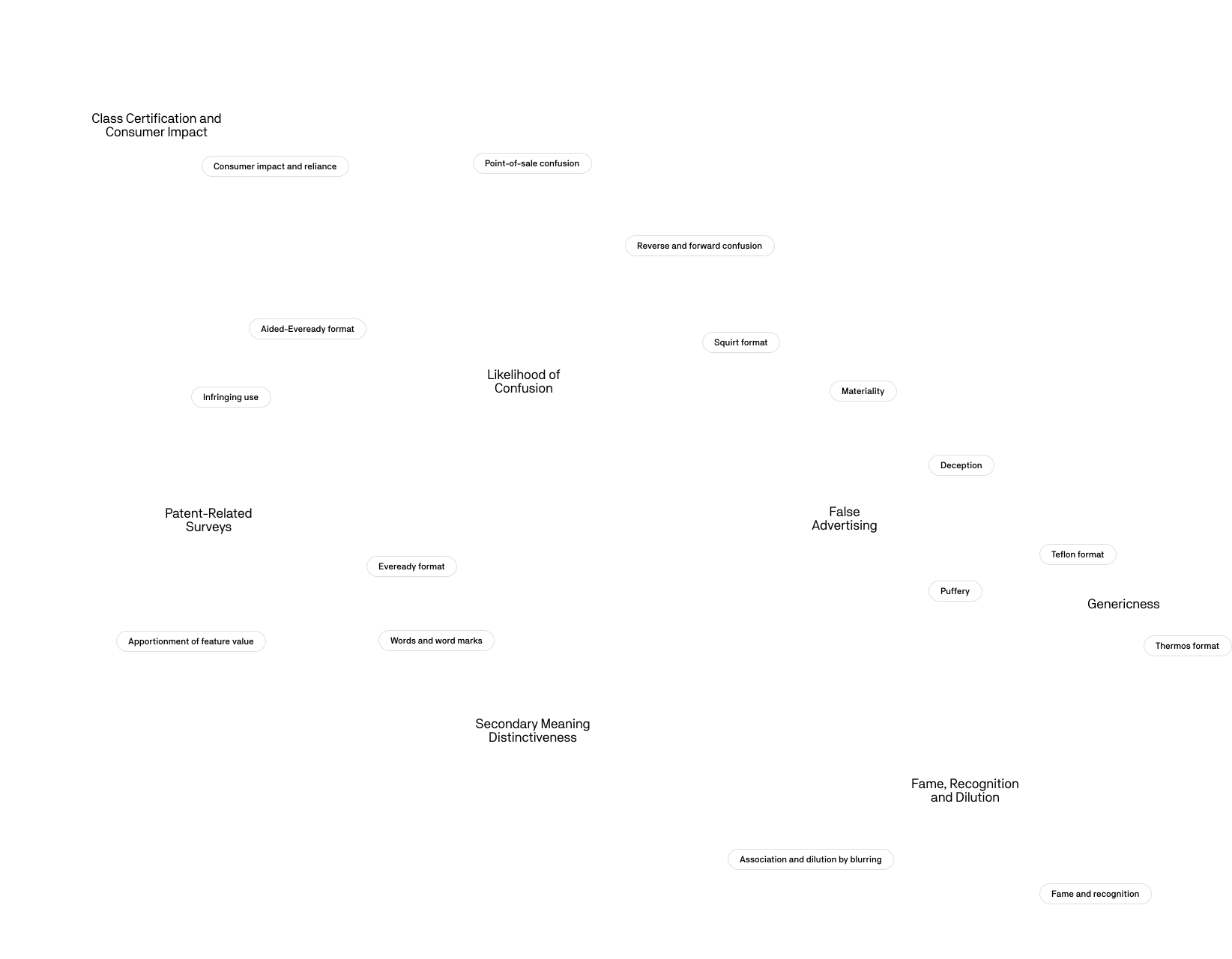

Patent-Related Surveys
Consumer surveys in patent litigation serve a range of distinct evidentiary purposes, including measuring the value consumers place on specific patented product features, establishing the nature and extent of consumer use of an accused product or method, and addressing the role of marketing or technical instructions in directing consumer behavior toward the claimed invention. The design of patent surveys requires careful integration of consumer research methodology with the substantive legal and economic questions framed by the parties and the court. Dr. Neal has been retained as a survey expert in many patent matters before federal district courts, including cases involving consumer electronics, telecommunications, gaming, and medical devices.
Apportionment of Feature Value
Where a patent infringement damages award is based in whole or in part on the profits attributable to the patented technology, it is often necessary to apportion the value of the patented features as a subset of the value of the product as a whole. Consumer surveys can contribute to this apportionment analysis by providing empirical data on the value consumers assign to specific product features — including both the accused, patented features and unaccused features that may serve as controls — and by measuring how consumer purchasing behavior would change if particular features were absent or modified.
Direct Survey Methods and Conjoint Analysis
Two primary survey-based methodologies have been employed to address feature value apportionment in patent cases: direct survey methods and conjoint analysis.
Direct survey methods ask consumers to evaluate specific features explicitly — for example, by indicating their likelihood of purchasing the product when the at-issue feature is present (Test cell) and when it is absent (Control cell).
Conjoint analysis is a survey-based technique drawn from the marketing science literature in which respondents are presented with a series of hypothetical product profiles — each described by a different combination of features at varying levels — and asked to indicate their preferences among the profiles. By systematically varying features across profiles, conjoint analysis estimates the marginal utility or value that consumers assign to each feature relative to others. The conjoint results are often used to estimate the proportion of total product value attributable to the patented feature.
Infringing Use
Patent surveys can also address the question of infringing use: whether consumers, in the ordinary course of using the accused product, actually employ or practice the functionality claimed in the asserted patent. Surveys addressing this question present respondents with accessible descriptions of the relevant product features or steps and ask about their actual usage patterns, measuring the extent to which consumer behavior in real-world use involves the elements at issue in the patent.
Inducement
A party who actively induces another's direct infringement of a patent may be liable for induced infringement. Consumer surveys relevant to inducement claims can measure whether a defendant's instructions, product packaging, advertising, or other commercial communications directed consumers to use the product in a manner that practices the asserted patent claims. These surveys can examine what consumers understand the defendant's communications to direct or encourage, and whether consumers follow those directions in their actual use of the product.
Note
This summary captures general themes and principles that apply in many circumstances. All surveys in litigation are, however, unique to the facts, allegations and marketplace conditions at issue, and are customized accordingly.
Work With Dr. Neal

Work With Dr. Neal
To discuss a matter or explore whether a patent survey is appropriate for your case, contact Catalyst Behavioral Sciences for a confidential consultation.